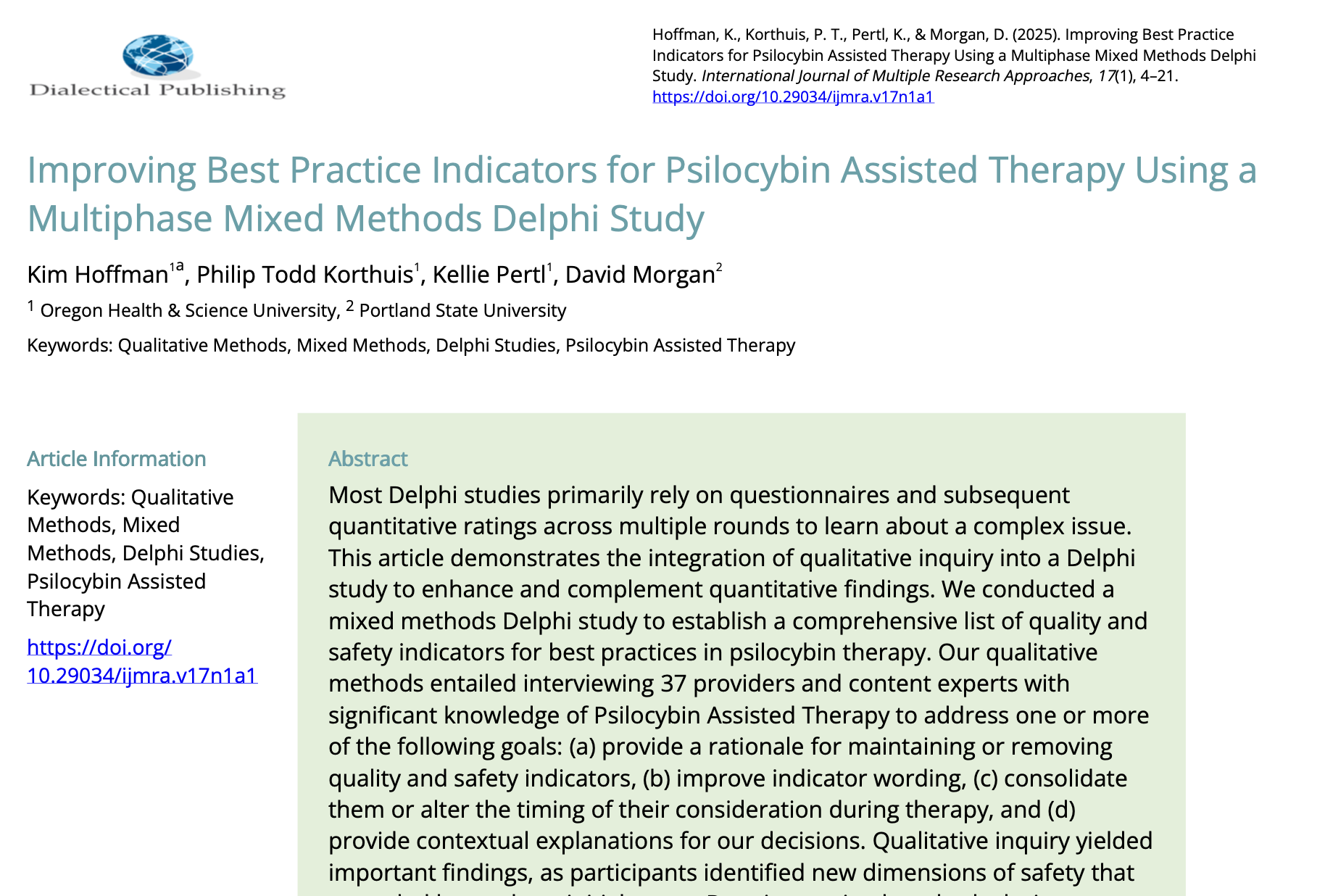
17(1). 02. Improving Best Practice Indicators for Psilocybin Assisted Therapy Using a Multiphase Mixed Methods Delphi Study
$30.00
Description
Authors
Kim Hoffman(1), Philip Todd Korthuis(1), Kellie Pertl(1), David Morgan(2)
(1) Oregon Health & Science University, (2) Portland State University
Abstract
Most Delphi studies primarily rely on questionnaires and subsequent quantitative ratings across multiple rounds to learn about a complex issue. This article demonstrates the integration of qualitative inquiry into a Delphi study to enhance and complement quantitative findings. We conducted a mixed methods Delphi study to establish a comprehensive list of quality and safety indicators for best practices in psilocybin therapy. Our qualitative methods entailed interviewing 37 providers and content experts with significant knowledge of Psilocybin Assisted Therapy to address one or more of the following goals: (a) provide a rationale for maintaining or removing quality and safety indicators, (b) improve indicator wording, (c) consolidate them or alter the timing of their consideration during therapy, and (d) provide contextual explanations for our decisions. Qualitative inquiry yielded important findings, as participants identified new dimensions of safety that extended beyond our initial scope. By using a mixed methods design, we demonstrate that both exploratory and explanatory qualitative methods can make a vital contribution to Delphi methods, extending beyond the use of quantitative ratings.